
Disclaimer: Who knows how much of this is true. I did not do independent research. I bought these heraldic citations at the Washington State Fair years ago.
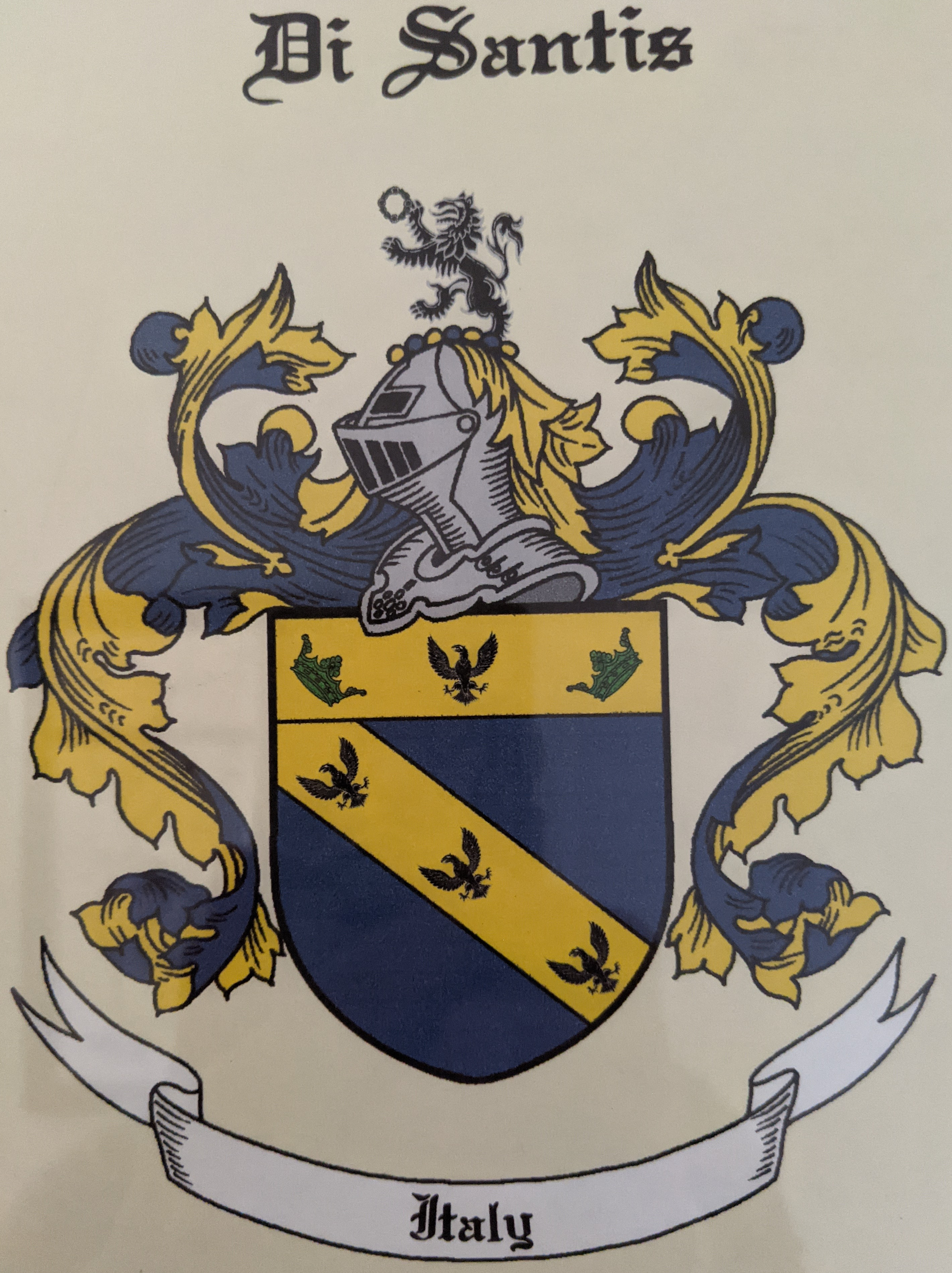
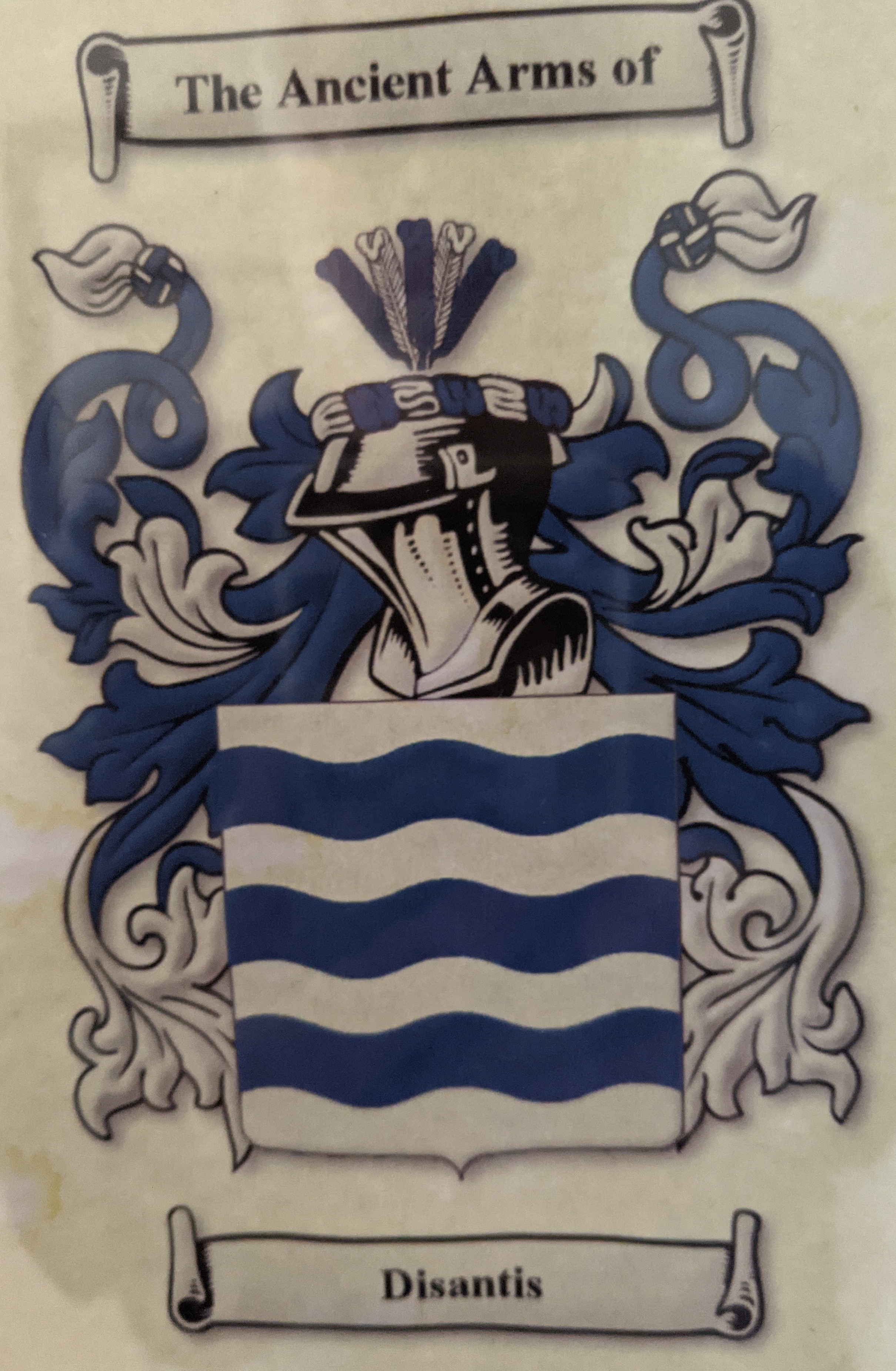
Two family crests: one from Italy and the other from Spain. It has always been curious to me why our name does not end in a vowel, like most Italian names, until I read this Spanish heraldry. Since the Spanish pre-dates the Italian, I assumed there was a migration to Italy at some point. If you read the Spanish citation, they indicated Roman soldiers retired in the conquered Hispania. Some Roman emperors were even born in Hispania before returning to Rome. However, according to my Ancestry there are no DNA links to the Iberian Peninsula. Curious.
So, my personal choice would be the Italian Coat of Arms because I know my paternal grandfather, Pietro DiSantis immigrated from Avellino, Italy, 47 km east of Naples. My paternal grandmother was also from the same area of Italy. My maternal grandparents were from Sicily. I’m going with the Italian crest.
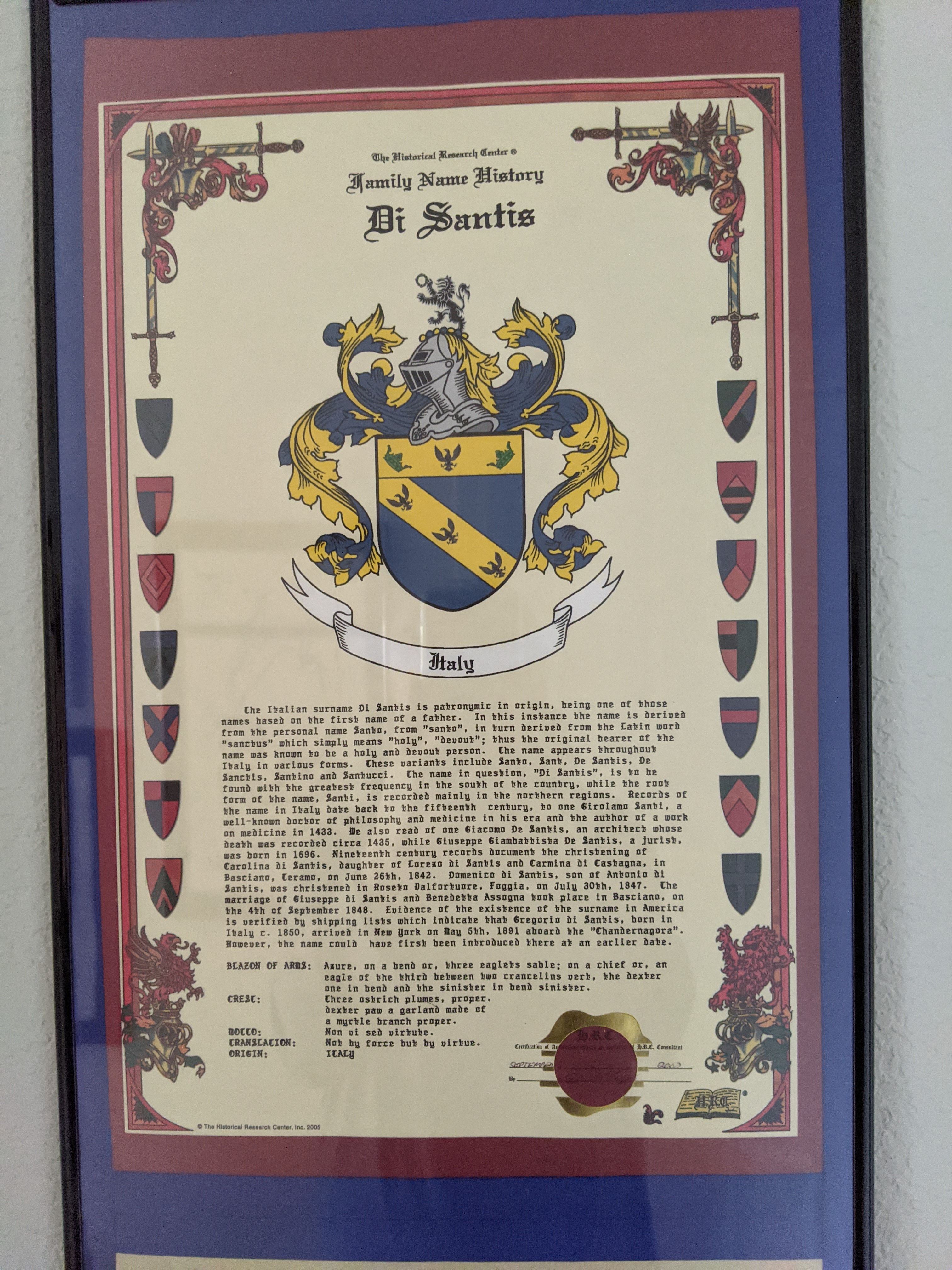
Italian Coat of Arms Citation
The Italian surname Di Santis is patronymic in origin, being one of those names based on the first name of a father. In this instance the name is derived from the personal name Santo, from “santo”, in turn derived from the Latin word “sanctus” which simply means “holy”, “devout”; thus the original bearer of the name was known to be a holy and devout person. The name appears throughout Italy in various forms. these variants include Santo, Sant, De Santis, De Sanctis, Santino and Santucci. The name in question, ”Di Santis”, is to be found with the greatest frequency in the south of the country, while the root form of the name, Santi, is recorded mainly in the northern regions. Records of the name in Italy date back to the fifteenth century, to one Girolamo Santi, a well-known doctor of philosophy and medicine in his era and the author of a work on medicine in 1433. We also read of one Giacomo De Santis, an architect whose death was recorded circa 1435, while Giuseppe Giambattista De Santis, a jurist, was born in 1696. Nineteenth century records document the christening of Carolina di Santis, daughher of Lorezo di Santis and Carmina bi Castagna, in Basciano, Ceramo, on June 26th, 1842. Domenico di Santis, son of Antonio di Santis, was christened in Roseto Valfortuore, Foggia, on July 30th, 1847. The marriage of Giuseppe di Santis and Benedetta Assogna took place in Basciano, on the 4th of September 1848. Evidence of the existence of the surname in America is verified by shipping lists which indicate that Gregorio di Santis, born in Italy c. 1850, arrived in New York on May 5th, 1891 aboard the ”Chandernagora”. However, the name could have first been introduced there at an earlier date.
BLAZON OF ARMS: Azure on a bend or, three eaglets sable; on a chief or, an eagle of the third between two crancelins vert, the dexter one in bend and the sinister in bend sinister.
CREST: Three ostrich plumes, proper, dexter paw a garland made of a myrtle branch proper.
MOTTO: Non vie sed virtute
TRANSLATION: Not by force but by virtue
ORIGIN: Italy
More details from the website http://hrc-500.appspot.com/
CREST: A symbol (sometimes more than one) relating to hopes, ambitions or status
A lion rampant sable, holding in the dexter paw a garland made of a myrtle branch proper.
SYMBOLISM: The meaning of symbols (known as charges) and colors on the Coat of Arms and Crest. These represented the hopes, dreams and ambitions of bearers of this heraldry insignia.
Azure – A bright blue color which represents truth and loyalty. Bend – A diagonal bar on the shield which signifies the scarf or shield suspender of a knight commander and stands for defense or protection. Chief – The upper part of the shield. It was often granted as a special reward for prudence and wisdom or successful military command. Crancelin – A diagonal bar topped with a shape similar to the profile of a crown. Eagle – The eagle plays an important part in heraldry in almost every part of the globe and denotes a person of noble nature, strength, bravery and alertness. Or – The color gold. It denotes the qualities of generosity and elevation of mind. Sable – Black. This color denotes constancy or grief. This may also refer to the animal Sable prized for its fur. Vert – The color green. Represents the qualities of hope, joy and loyalty in love.
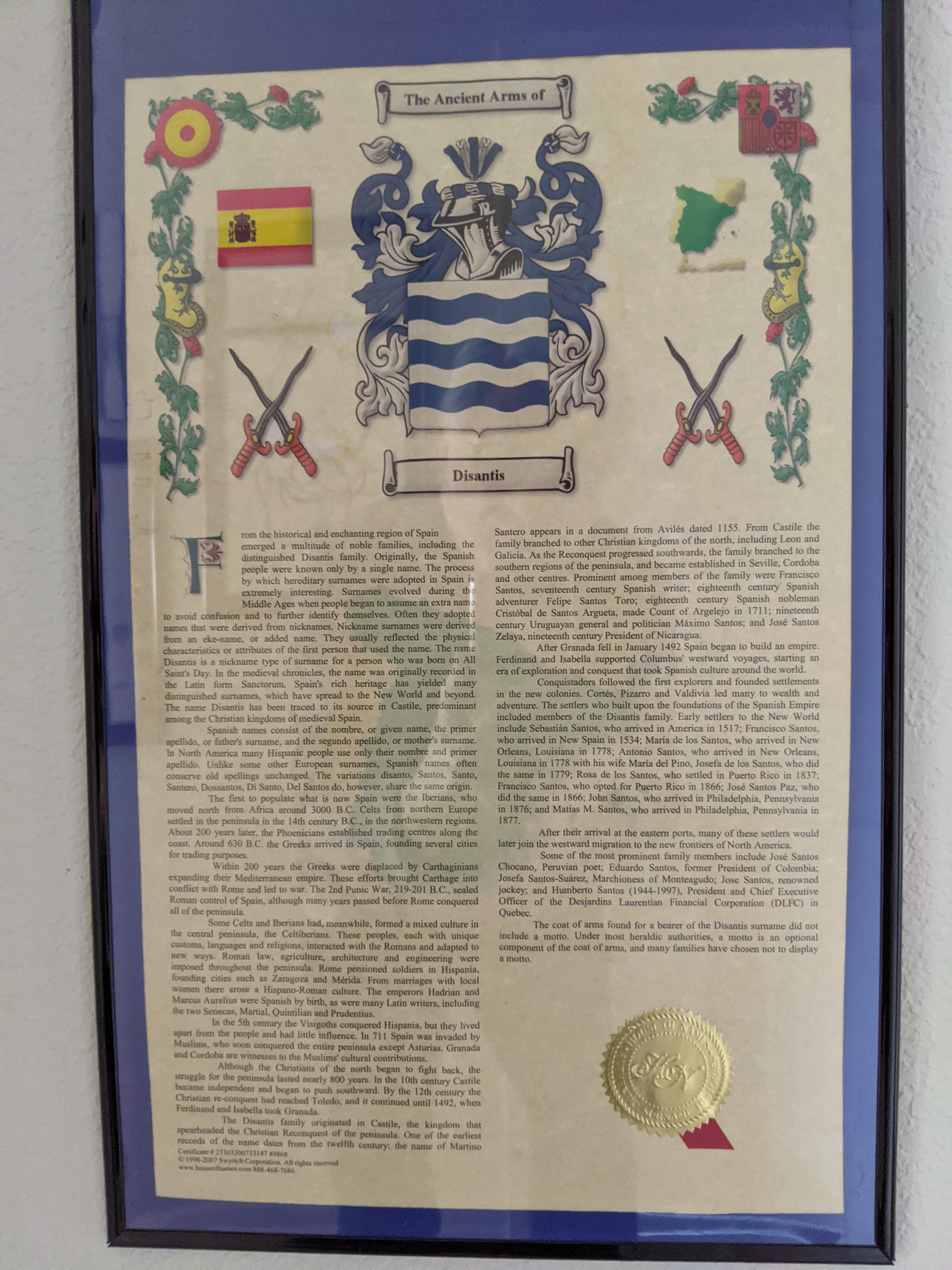
Spanish Coat of Arms Citation
From the historical and enchanting region of Spain emerged a multitude of noble families. including the distinguished Disantis family, Originally, the Spanish people were known only by a single name. The process by which hereditary surnames were adopted in Spain is extremely interesting. Surnames evolved during the Middle Ages when people began to assume an extra name to avoid confusion and to further identify themselves. Often, they adopted names which were adopted from nicknames. Nickname surnames were derived from an eke-name or added name. They usually reflected the physical characteristics or attributes of the first person that used the name. The name Disantis is a nickname type of surname for a person who was born on All Saints Day. ln the medieval chronicles, the name was originally recorded in Latin form Sanctorum. Spain’s rich heritage has yield many distinguished surnames, which have spread to the New World and beyond. The name Disantis has been traced to its source in Castile, predominant among the Christian kingdoms of medieval Spain.
Spanish names consisted of the nombre or given name, the primer apeliido, or father’s surname and the segundo apellido, or mother’s surname. ln North America many Hispanic people use only their nombre and primer apeliido. Unlike some other European surnames. Spanish names often conserve old spellings unchanged. The variations disanto, Santos, Santo, Santero, Dossantos, De Santo, Del Santos do. however, share the same origin.
The first to populate what is now Spain were the Iberians, who moved north from Africa around 3000 B.C. Celts from northern Europe settled in the peninsula in the 14th century B.C.in the northwestern regions. About 200 years later, the Phoenicians established trading centres along the coast. Around 630 B.C. the Greeks arrived in Spain, founding several cities for trading purposes.
Within 200 years the Greeks were displaced by Carthaginians expanding their Mediterranean empire. These efforts brought Carthage into conflict with Rome and led to war. The 2nd Punic War, 219·201 B.C., sealed Roman control of Spain, although many years pasted before Rome conquered the peninsula.
Some Celts and Iberians had, meanwhile, formed a mixed culture in the central peninsula, the Celtiberians. The peoples. each with unique customs, languages and religion, interacted with the Romans and adapted to new ways. Roman law, agriculture, architecture and engineering were imposed throughout the peninsula. Rome pensioned soldiers in Hispania founding cities such as Zaragoza and Mérida. From marriages with local women there arose a Hispano-Roman culture. The emperors Hadrian and Marcus Aurelius were Spanish by birth, as were many Latin writers including the two Senecas, Martial, Quintilian and Prudentius.
In the 5th century, the Visigoths conquered Hispania, but they lived apart from the people and had little influence. ln 711 Spain was invaded by Muslims, who soon conquered the entire peninsula except Asturias. Granada and Cordoba are witnesses to Muslim cultural contributions.
Although the Christians of the North began to fight back, the struggle for the peninsula lasted nearly 800 years. In the 10th century Castile became independent and began to push southward. By the 12th century the Christian re-conquest had reached Toledo, and it continued until 1492, when Ferdinand and Isabella took Granada.
The Disantis family originated in Castile, the kingdom that spearheaded the Christian reconquest of the peninsula. One of the earliest records of the name dates from to the twelfth century: the name Martino Santero appears in a document from Avilés dated 1155. From Castile the family branched to other Christian kingdoms of the north, including Leon and Galicia. As the Reconquest progressed southwards, the famiIy branched to the southern regions of the peninsula, and became established in Seville, Cordoba and other centres. Prominent among members of the family were Francisco Santos, seventeenth century Spanish writer; eighteenth century Spanish adventurer Felipe Santos Toro; eighteenth century Spanish nobleman Cristóbal de Santos Argueta made Count of Argelejo in 1711; nineteenth century Uruguayan general and politician Maximo Santos; and José Santos Zelaya, nineteenth century President of Nicaragua.
After Granada fell in January 1492 Spain began to build an empire. Ferdinand and Isabella supported Columbus’ westward voyages, starting an era of exploration and conquest that took Spanish culture around the world.
Conquistadors followed the first explorers and founded settlements in the new colonies. Cortés, Pizarro and Valdivia led many to wealth and adventure. The settlers who built upon the foundations of the Spanish Empire included member of the Disantis family. Early settlers to the include Sebastián Santos, who arrived in America in 1517; Francisco Santos, who arrived in New Spain in 1534; Maria de los Santos, who arrived in New Orleans, Louisiana in 1778; Antonio Santos, who arrived in New Orleans, Louisiana in 1778 with his wife Maria del Pino; Josefa de los Santos who did the same in 1779; Rosa de los Santos, who settled in Puerto Rico in 1837; Francisco Santos, who opted for Puerto Rico in 1866; José Santos Paz, who did the same in 1866; John Santos, who arrived in Philadelphia, Pennsylvania in 1876; and Matias M. Santos who arrived in Philadelphia, Pennsylvania in 1877.
After their arrival in the eastern ports, many of these settlers would later join the western migration to the new frontiers of North America.
Some of the most prominent family members included José Santos Chocano, Peruvian poet; Eduardo Santos, former President of Colombia; Josefa Santos-Suárez, Marchioness of Monteagudo; Jose Santos renowned jockey; and Humberto Santos (1944-1997), President and Chief Executive Officer of the Desjardins Laurentian Financial Corporation (DLFC) in Quebec.
The coat of arms found for a bearer of the Disantis surname did not include a motto. Under most heraldic authorities, a motto is an optional component of the coat of arms and many families have chosen to not display a motto.
More information at https://www.houseofnames.com/disantis-family-crest
Discover more from DiSantis Family Table
Subscribe to get the latest posts sent to your email.
